Starting a sketchbook practice can feel intimidating—especially when the blank page feels louder than your ideas. The purpose of a sketchbook is not perfection. It is a space for movement, exploration, mistakes, and discovery. A place where your hands can lead before your mind tries to control the outcome.
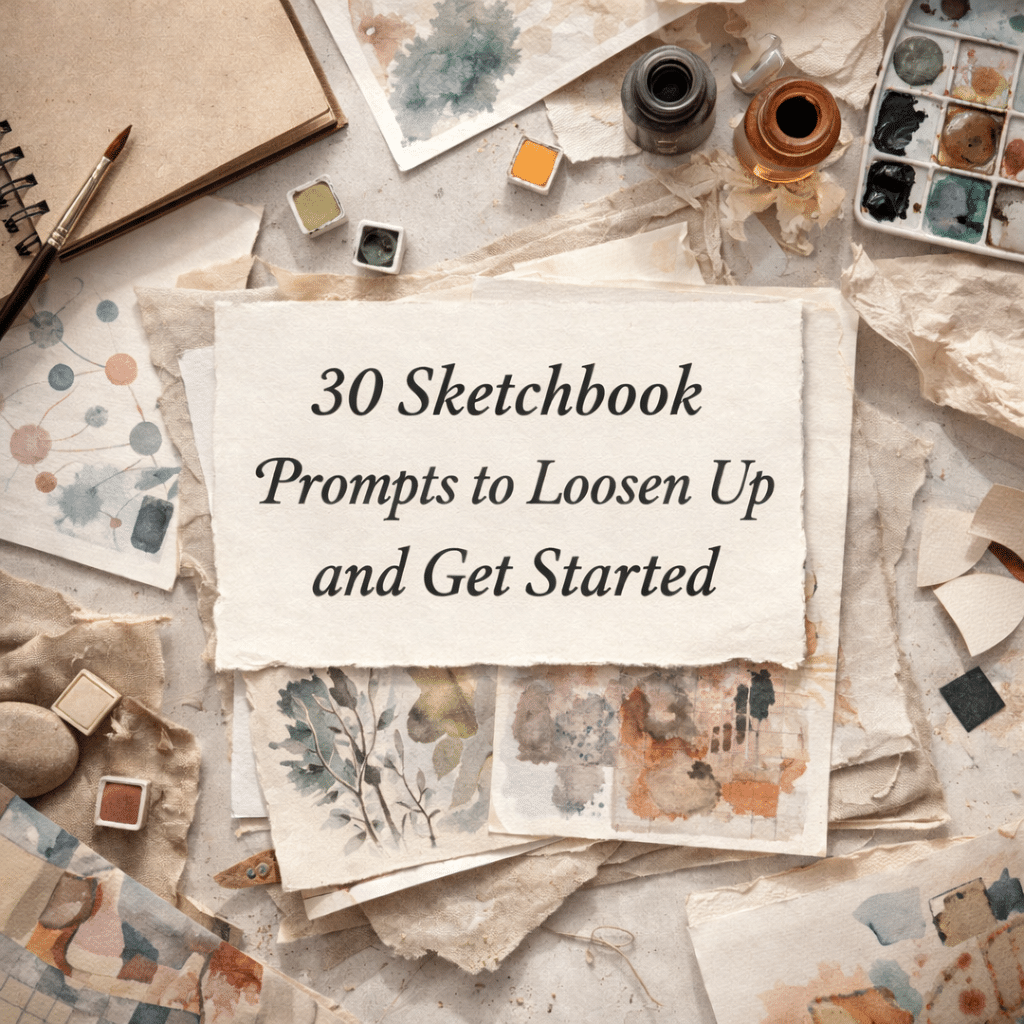
These 30 sketchbook prompts are designed to help you loosen up, get out of your head, and simply begin. They are intentionally open-ended, process-driven, and playful.
Use them as warm-ups, daily prompts, or whenever you feel creatively stuck. There is no right or wrong way to approach them—follow your curiosity and let the page hold whatever shows up.
1. Letting Go and Making Marks
Prompts to loosen control, build confidence, and reconnect with intuition.
These prompts encourage freedom, spontaneity, and imperfection. They are especially helpful when you feel blocked or overly self-critical.
- Connect the Dots: Place seven random dots on your page and connect them using patterns, textures, and colors.
- Non-Dominant Hand: Create an abstract piece using only your non-dominant hand to get unexpected and unique marks.
- Altered Surface: Crumple your paper or apply a textured medium before painting to add an interesting base layer.
- Monochrome Magic: Use only one color in various shades and tones to create depth and interest.
- Single Tool: Limit yourself to using just one tool, like a palette knife or sponge, to explore different techniques.
- Eyes Closed: Paint with your eyes closed for a few minutes to focus on the feel of the brush and the movement of your hand.
- Bold Moves: Make a bold, unexpected stroke or use a color you wouldn’t normally choose. Embrace the unexpected!
- New Color Combo: Experiment with a color combination you’ve never used before. Mix bright and muted tones for contrast.
- Music Inspiration: Listen to a piece of music and let the rhythm and mood guide your brushstrokes and color choices.
- Emotion Expression: Think of a strong emotion and translate it into abstract forms and colors on your canvas.
2. Exploring Mixed Media and Texture
Prompts to experiment with materials, layers, and tactile surfaces.
This section focuses on discovery through materials. Let curiosity guide you rather than outcomes.
- Layered Textures: Start with a base layer of acrylic paint. Add texture by applying modeling paste with a palette knife, then layer with watercolor washes.
- Collage Elements: Create a background using watercolor. Once dry, add collage elements like magazine clippings, fabric scraps, or old photographs using gel medium.
- Stamping and Stenciling: Use stamps and stencils with ink or acrylic paint to create patterns and layers. Experiment with overlapping and combining different designs.
- Mixed Media Portrait: Draw a simple portrait with charcoal or pencil. Enhance it by adding layers of pastel, ink, and acrylic paint for a dynamic, textured look.
- Found Objects: Incorporate found objects like leaves, buttons, or pieces of fabric into your artwork. Attach them using glue or gel medium and paint over them to integrate them into the piece.
- Resist Techniques: Use masking fluid or wax crayons to create resist areas on your paper. Paint over with watercolors or inks, then remove the resist to reveal the underlying design.
- Impasto and Glazing: Apply thick layers of acrylic paint with a palette knife for an impasto effect. Once dry, add thin glazes of color to create depth and richness.
- Alcohol Inks and Yupo Paper: Experiment with alcohol inks on Yupo paper. Use a straw or air blower to move the ink around and create abstract patterns.
- Gesso and Pastels: Apply a layer of gesso to your paper. Once dry, draw over it with soft pastels, blending the colors with your fingers or a blending tool.
- Digital and Traditional Mix: Print a digital image or pattern onto your paper. Enhance it with traditional media like acrylics, inks, or colored pencils to create a hybrid artwork.
3. Shapes, Space, and Composition
Prompts to develop visual awareness without overthinking.
These exercises help you understand balance, structure, and negative space in an intuitive way.
- Negative Space Exploration: Draw an object or scene, but focus on filling in the negative space around it with patterns, colors, or textures.
- Geometric Shapes: Create an abstract piece using only geometric shapes like circles, triangles, and squares. Experiment with overlapping and layering them.
- Organic Forms: Draw or paint using only organic, flowing shapes inspired by nature. Think of leaves, waves, or clouds.
- Silhouette Study: Paint a scene or object in silhouette, focusing on the contrast between the solid shapes and the background.
- Shape Collage: Cut out various shapes from colored paper or magazines and arrange them into an abstract composition on your sketchbook page.
- Shadow Play: Use a light source to cast shadows of objects onto your paper. Trace the shadows and fill them in with interesting patterns or colors.
- Contour Lines: Draw an object or scene using only continuous contour lines. Avoid lifting your pen or pencil from the paper.
- Symmetry and Asymmetry: Create two abstract pieces side by side—one that is symmetrical and one that is asymmetrical. Compare the balance and visual interest of each.
- Layered Shapes: Paint or draw a series of overlapping shapes, using transparency or different opacities to create depth and complexity.
- Negative Space Cutouts: Cut shapes out of a piece of paper and use the cutouts as stencils. Paint or draw through the stencils to create interesting negative space designs.
Final Thoughts
Your sketchbook does not need to be impressive—it needs to be honest and active. These prompts are invitations, not instructions. Some pages will feel resolved, others messy or incomplete. All of them count.
Return to these prompts whenever you feel stuck, unsure, or overly focused on outcomes. Over time, you’ll notice patterns in your marks, colors, and choices. That awareness becomes the foundation for a more confident and personal art practice.
Start small. Stay curious. Let the sketchbook hold the process.