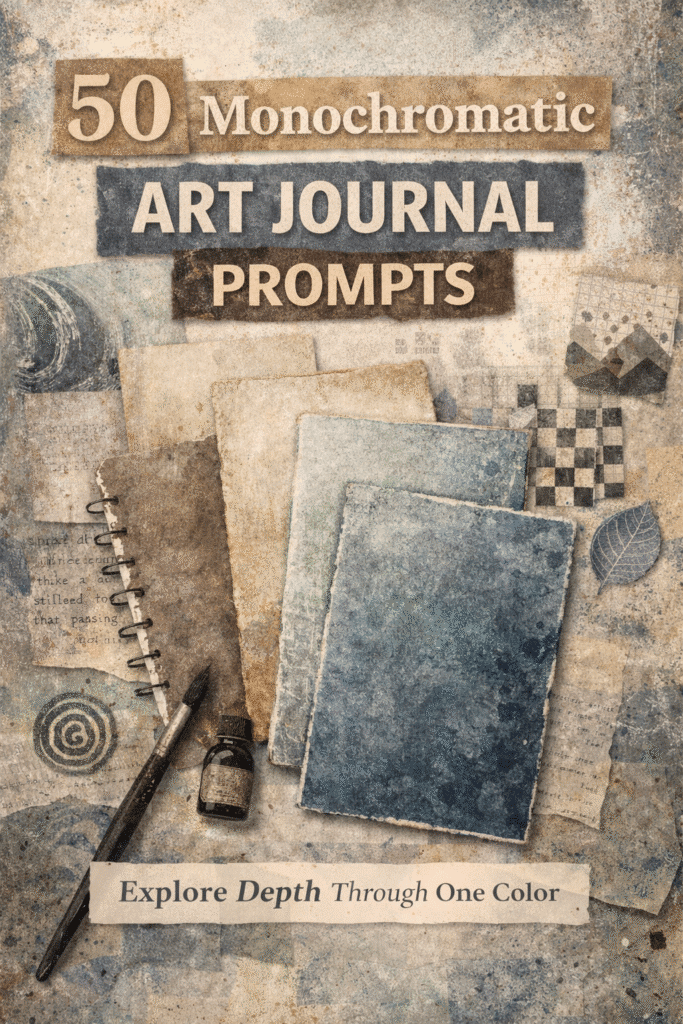
Working with a single color can feel limiting at first—but in art journaling, monochromatic work often leads to deeper expression. When color choice is simplified, your attention naturally shifts to texture, shape, movement, emotion, and mark-making.
These prompts are designed to help you explore one color at a time—using its light, dark, muted, and layered variations—to create expressive, intuitive art journal pages. You can repeat the prompts with different colors on different days, or stay with one color for an entire series.
This is not about perfection or realism. It is about slowing down, noticing subtle shifts, and allowing one color to carry a story.
How to Use These Prompts
Choose one color for each page (for example: muted blue, earthy red, soft green, smoky violet)
Use tints (add white), shades (add black), and muted mixes (add neutrals)
Combine paint, pencil, collage, ink, stitching, or text
Let the prompt guide you—but do not overthink the outcome
50 Monochromatic Art Journal Page Prompts
A Moment in One Color
Illustrate a meaningful moment from your week using only one color and its variations.A Place You Haven’t Been
Imagine a place you long to visit. Focus on mood rather than details.Texture Study
Explore rough, smooth, layered, and scraped textures using a single color.Minimal Object
Choose one simple object and reduce it to basic shapes and marks.Abstract Shapes
Let shapes, lines, and negative space emerge intuitively.Emotional Landscape
Create a landscape that mirrors your current emotional state.Words + Color
Add a meaningful word or phrase and let the color respond to it.Fading Forms
Create shapes that slowly dissolve or fade into the background.Emotional Maze
Use lines and paths to represent confusion, clarity, or transition.Silent Dialogue
Show a conversation between two shapes or forms—without words.Monochrome Still Life
Paint everyday objects using only tonal variation.Shadow Play
Focus on shadows and depth rather than the object itself.Imaginary Constellations
Create dots and lines that form your own symbolic sky.Sea in One Color
Abstractly express waves, movement, or stillness.Ink or Paint Flow
Let liquid media move freely across the page.Abstract Body
Suggest parts of the body using organic shapes.Echoes
Repeat shapes or marks that gradually grow lighter.Cosmic Fragments
Imagine broken planets, stars, or floating forms.Connections
Use lines or threads to show relationships or memories.Leaves and Air
Capture movement rather than form.Poetry + Paint
Write a short poem and build color around it.Imaginary Architecture
Create structures that feel stable, fragile, or chaotic.Emotional Ripples
Use circles or waves to show emotional impact.Hidden Doors
Suggest passageways or openings.Dream Forms
Paint shapes that feel dreamlike or surreal.Fire Energy
Express warmth, intensity, or transformation.Cosmic Balance
Show harmony through repetition and spacing.Invisible Maps
Create a map that leads somewhere emotional, not physical.Abstract Calligraphy
Turn words into marks and movement.Monochromatic Collage
Add torn paper or fabric in similar tones.Frozen Sound
Represent sound waves paused in time.Swirling Motion
Use circular or spiral movement.Veiled Memories
Layer translucent shapes like fog or mist.Pattern Play
Explore organic or geometric repetition.Transformation
Let one shape evolve into another.Time Passing
Use symbols or rhythm to show change.Emotional Fragments
Paint broken or scattered forms.Secrets
Hide marks or symbols beneath layers.Comfort
Create shapes that feel like a gentle embrace.Foreign Word
Write a word from another language and abstract it.Forest Sounds
Capture rustling, depth, and density.Broken Objects
Show fragments reconnecting.Bridges
Connect distant shapes or spaces.Color Haiku
Write a short haiku inspired by the color.Cosmic Echoes
Extend repetition into space.Emotional Waves
Show highs and lows through movement.Inner Anatomy
Abstractly explore what’s beneath the surface.Light
Paint glow, reflection, or filtered brightness.Memory Sculptures
Imagine memories as physical forms.Night Stillness
Capture quiet, darkness, and pause.
Closing Thought
You can return to these prompts again and again—each time with a different color, a different mood, or a different season of life. Monochromatic work is not about limitation. It is about listening more closely to what wants to surface.