There’s a moment that many artists don’t talk about.
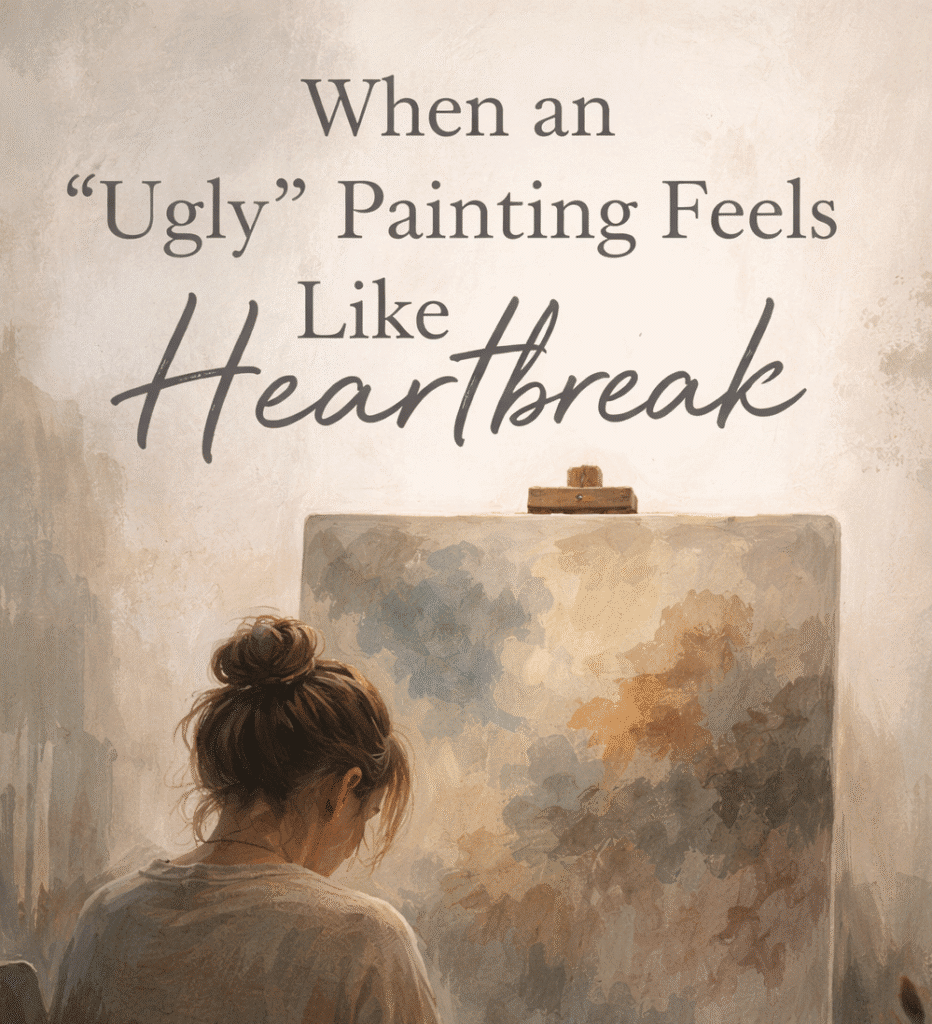
You sit down to paint.
You begin with openness, maybe even excitement.
And then something shifts.
The painting doesn’t go the way you imagined.
The colors don’t sit right.
The composition feels off.
It starts to look… wrong.
And suddenly, it’s no longer just a painting.
Your chest tightens. There’s a sinking feeling. Almost like loss.
Almost like rejection. Almost like something inside you is breaking.
And the thought comes in quietly, but sharply: “This is bad.”
Followed by — “What does this say about me?”
If you’ve ever felt this, you might have assumed:
- “I need to improve my skills.”
- “I need better ideas.”
- “I should plan more.”
But none of those are the real issue.
What you’re experiencing is something much deeper.
The Hidden Equation: When Art Becomes Identity
At some point — slowly, subtly — this equation forms:
My art = me
So when the painting feels “ugly,” your system doesn’t read it as: “This piece isn’t working.”
It reads it as: “Something about me isn’t working.”
That’s why the pain feels personal.
That’s why it feels physical.
That’s why it can resemble heartbreak.
Because your nervous system is not reacting to paint.
It is reacting to perceived rejection of self.
Why It Feels Like a Breakup
In my body, it feels the same as I felt after breakups. That’s not an exaggeration.
Your body is using the same emotional pathway:
- Rejection
- Loss of connection
- Not being chosen
- Not being enough
An “ugly painting” triggers: “If this is seen, I may not be accepted.”
And your system responds: Danger. Withdraw. Protect.
So the urge comes:
- to stop
- to fix
- to hide
- to avoid looking at it
Not because you lack skill —
but because your system is trying to protect you from emotional pain.
Perfection Was Never About Art
Perfectionism, in this context, is not about high standards. It is a safety strategy.
If the work is perfect:
→ You are safe from judgment
→ You are safe from rejection
→ You are safe from feeling that pain
If the work is imperfect:
→ The risk feels real
→ The exposure feels dangerous
So your system tries to control the outcome. Not for excellence. But for emotional safety.
The Real Fear Is Not “Bad Art”
Let’s be very clear:
You are not afraid of making a bad painting. You are afraid of what a bad painting means. And what it currently means (in your system) is:
→ “I might not be good enough.”
→ “I might be rejected.”
→ “Something is wrong with me.”
That’s the real charge.
Why You Reach for References
Now this connects to your other pattern. When you look for a reference image or someone else’s work, you’re not being “less creative.”
Because:
- There is a structure
- There is a known path
- There is less risk of “doing it wrong”
So your system relaxes.
Not because it trusts your ability — but because the uncertainty is reduced.
What Needs to Shift
You don’t need:
- more skill
- more ideas
- more discipline
You need a new internal equation.
From: My art = me
To: My art = expression (separate from my worth)
And from: Imperfect = danger
To: Imperfect = process
The New Truth (read this slowly)
A painting can be:
- messy
- unresolved
- awkward
- “ugly”
And none of that defines you.
It only means: you are in the middle of exploration
The Real Work of an Artist
Not technique.
Not style.
Not even consistency.
The real work is this:
To remain emotionally stable while creating something that might not work.
Because that is where:
- originality is born
- expression becomes real
- your voice emerges
A Gentle Reframe
Next time you see a painting that feels “bad,”
instead of asking: “Why is this wrong?”
Ask: “Can I stay with this… without collapsing?”
That is the shift.
Final Thought
You are not trying to become a perfect artist.
You are becoming someone who can:
- create without certainty
- be seen without collapsing
- continue even when it doesn’t look right
Because that is where freedom lives.
And that is the kind of artist you actually want to be.