If you’ve been following my work for a while, you’ve mostly seen my hands — painting, layering, stitching, building pages.
But not so much my face or me talking about myself.
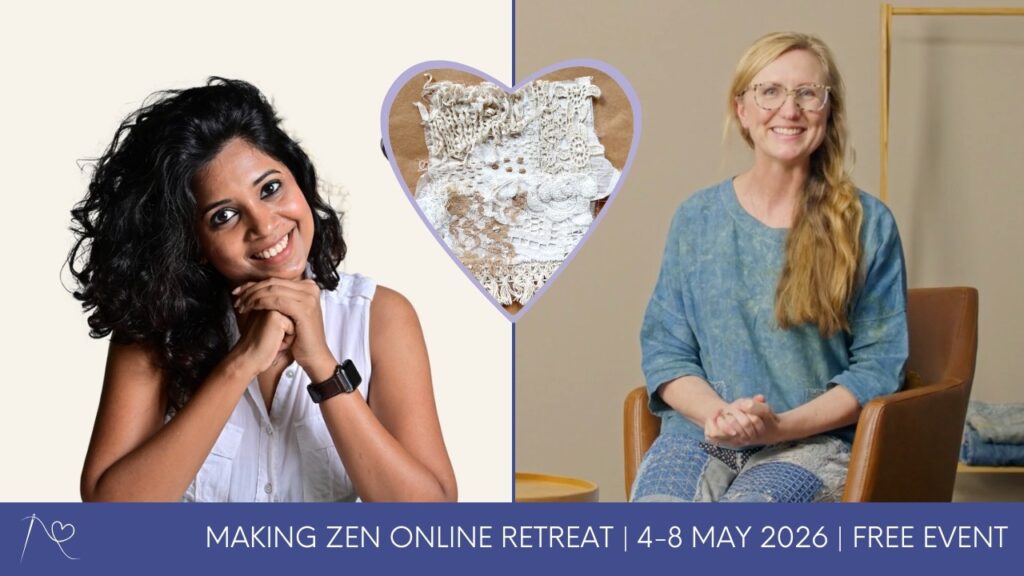
This conversation with Kate for the Making Zen retreat is one of those rare spaces where I sat down and shared my journey openly — not just what I do, but how I think, how I arrived here, and what truly shifted things for me.
And honestly, even for me… listening back to this conversation felt inspiring.
There’s something about the way Kate asks questions — it gently opens you up. It makes you reflect, go deeper, and speak more honestly than you planned to.
I really appreciated that.
🎥 Watch the Full Interview
1. My Journey: From Structure to Self-Expression
I started my career as an IT professional and spent over a decade working in a corporate environment.
Creativity was always there, but it wasn’t something I actively pursued.
That changed when I was living in London.
I found myself visiting art museums almost every single day after work — especially the Tate Modern. I didn’t fully understand what I was seeing at the time, especially installations, but I felt deeply drawn to them.
Looking back now, I realize that was my first reconnection with art.
For about three years, I lived a dual life:
- working during the day
- absorbing art and painting at night
That phase was crucial. It wasn’t glamorous. It was quiet, consistent, and self-driven.
2. The First Shift: Choosing Art
In 2015, I made the decision to leave my job.
There was no clear plan. No guarantee of income.
But I had built enough trust in myself through consistent practice to believe that I would figure it out.
That decision came from action, not certainty.
3. The Second Shift: From Approval to Authenticity
Even after becoming a full-time artist, I wasn’t fully myself.
I started by creating landscapes — because that’s what felt acceptable, what people understood, what I thought would work.
And it did work… externally.
But internally, something felt off.
I was always drawn to abstract, intuitive, expressive work — but I kept that part hidden for a long time.
The real shift happened when I started listening to that inner voice.
When I allowed myself to:
- create what felt true
- express raw marks and emotions
- stop filtering my work for acceptance
That transition changed everything.
4. The Role of Personal Growth
This shift wasn’t just artistic — it was deeply personal.
Reconnecting with my husband played a big role in this phase of my life. It helped me feel safe enough to be myself, without hiding behind fear, guilt, or the need for validation.
As I became more honest in my life, my art became more honest too.
And I started noticing something interesting:
- The more I created authentically → the better my life felt
- The more aligned I felt → the more my work connected with others
5. What I Believe About Creativity
One of the things I spoke about in the interview is this:
I don’t believe we run out of inspiration.
I truly feel inspiration comes from within.
But there’s a condition —
You have to take action.
6. The Simplest Way to Overcome Creative Blocks
If there’s one takeaway from this entire conversation, it’s this:
Not perfectly. Not with a plan.
Just:
- scribble
- make marks
- sit with your materials
Even for 5 minutes.
Because the hardest part is not creating —
it’s starting.
Once you begin, something shifts. Momentum builds naturally.
7. My Daily Practice (Simple but Powerful)
Right now, I follow a very simple structure:
- Create daily (even 10–20 minutes)
- Reduce resistance by keeping things easy
- Allow play instead of pressure
Even on days when I don’t feel like it — especially on those days — I sit down for a few minutes.
And almost always, those 5 minutes turn into much more.
8. A Breakthrough in My Process
One of the biggest changes in my art came from something very simple:
I stopped working only on expensive materials.
Instead, I started:
- painting on loose papers
- using simple, inexpensive materials
And that removed the pressure to “make something good.”
It gave me freedom to explore, play, and create more.
Now those loose pieces become:
- collages
- journal pages
- layered artworks
9. How I Work Today
My process is intuitive and fluid.
I often work across multiple sketchbooks or surfaces at once, depending on what I feel like doing:
- painting
- collage
- stitching
- bookmaking
There are no rigid rules — only what feels right in the moment.
10. What This Interview Really Is
This conversation is not just about techniques or projects.
It’s about:
- trusting yourself
- taking action
- letting go of external validation
- creating from a place of truth
And if you’ve ever felt stuck, unsure, or like you’re holding yourself back…
I think you might find something here that speaks to you.
Closing
I’m really grateful to Kate for holding this space.
Somehow, she has a way of asking questions that make you pause, reflect, and answer more honestly than you expect.
And for me, this conversation became exactly that —
a space of reflection, honesty, and clarity.