There’s a moment many art journalers experience after creating the first layer of a page. The collage papers are down. The colors feel beautiful. There’s texture, movement, atmosphere…
…and then the question arrives: “Now what?”
- What should the focal point be?
- Should the page mean something?
- Should you start with a prompt?
- Or should you simply follow intuition and see where the page goes?
For a long time, I thought there must be one “correct” way to approach art journaling. But over time, I realized something important:
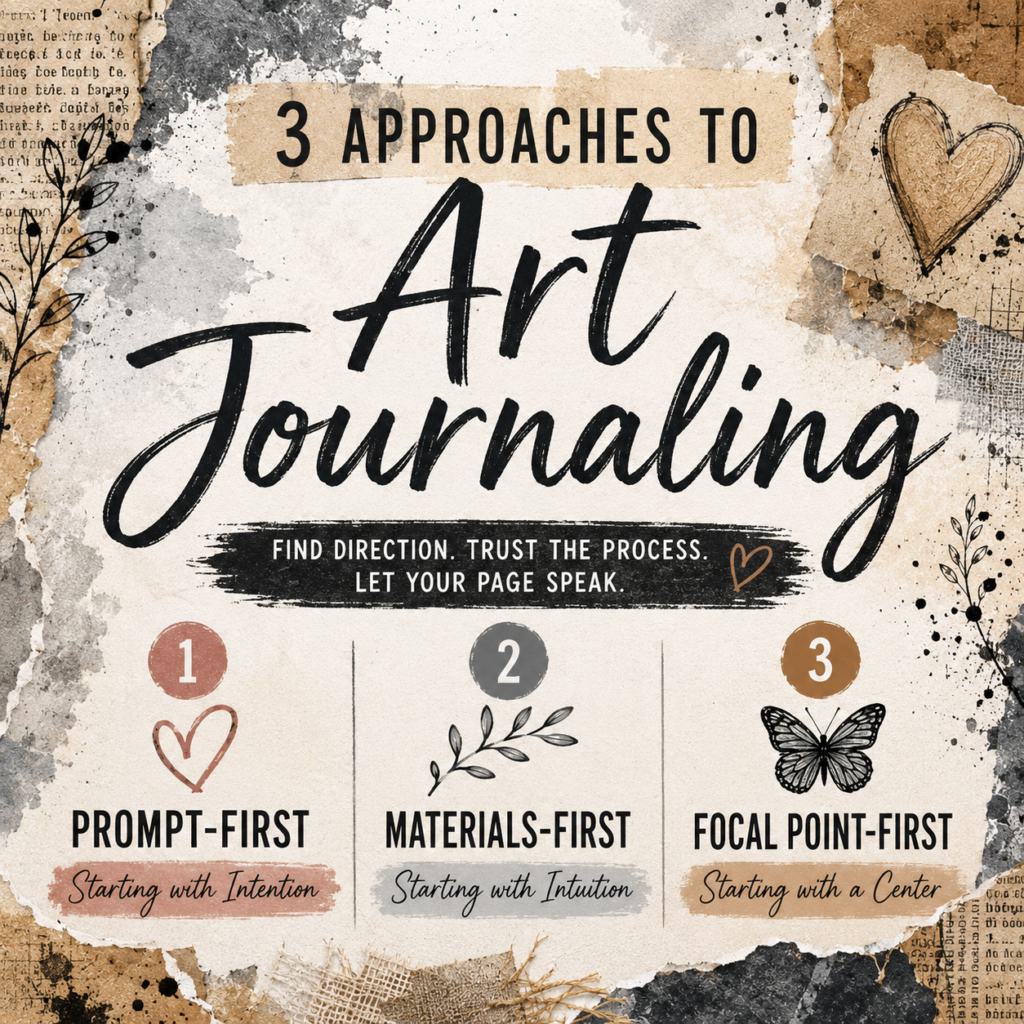
There are multiple valid ways to begin a spread. And understanding these approaches can completely change the way you create.
First, Let’s Talk About Layers
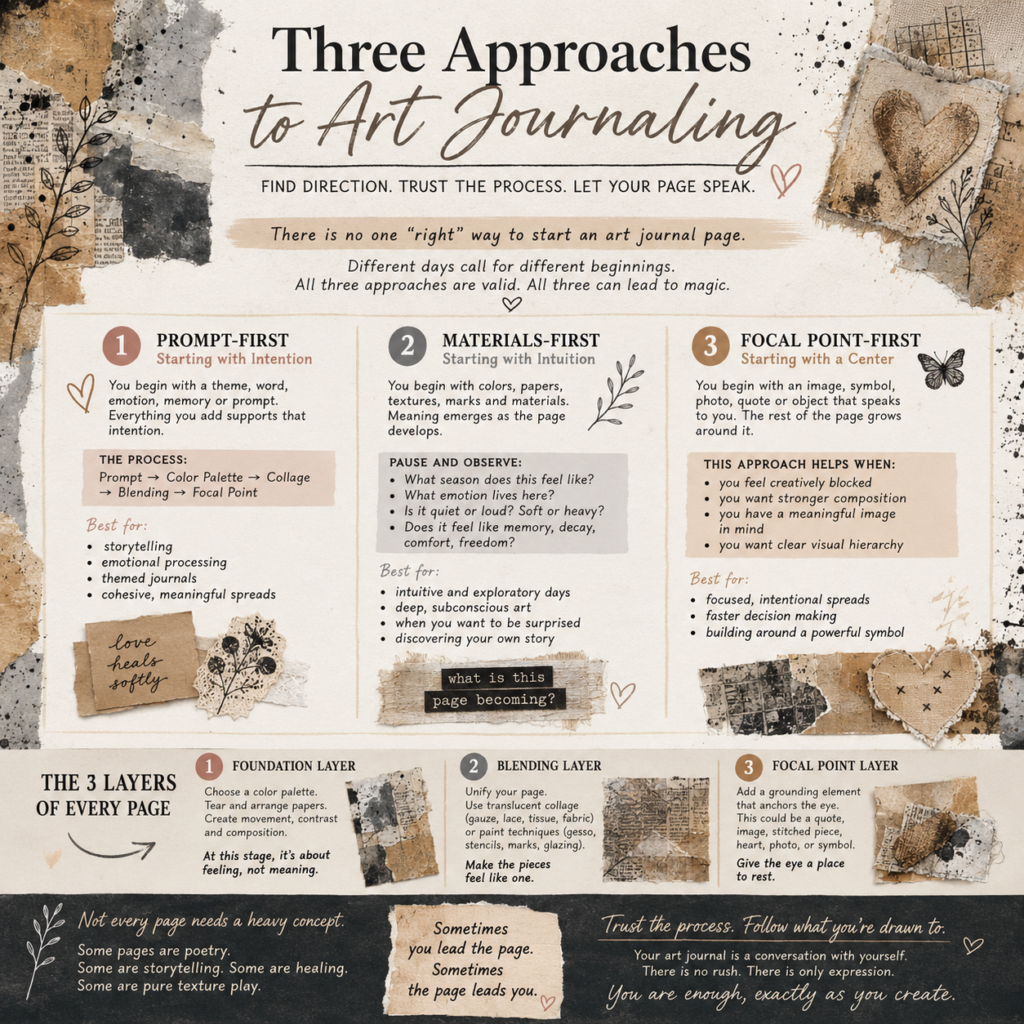
Most of my journal pages evolve in three stages:
1. The Foundation Layer
This is where I choose a color palette, tear & arrange collage papers, create movement and composition. At this stage, I’m not worrying too much about meaning. I’m simply responding to what I feel drawn to.
Sometimes it’s soft pinks and vintage papers. Sometimes it’s smoky grays, browns, and weathered textures. The page begins with attraction before explanation.
2. The Blending Layer
Once the collage papers are glued down, I begin integrating the page so it feels cohesive.
There are two main ways I do this:
1. Blending with more collage:
Translucent collage papers like tissue papers, deli papers, teabag papers & thin fabrics like gauze, lace, etc. These layers soften harsh edges and visually connect fragmented pieces together.
2. Blending with paint & gesso
Using gesso, paint & stencils, mark making, glazing, scratches, and texture. This creates harmony through repeated colors, marks, and surface treatments.
Sometimes I use only collage. Sometimes mostly paint. Sometimes a combination of both.
3. The Focal Point Layer
Finally, I add a grounding element.
This could be:
- a stitched fabric cluster,
- a quote, sentiment, found words
- a botanical image,
- a photograph / a figure / a symbol
- a handmade embellishment / cluster
The focal point gives the eye a place to rest. But here’s what I’ve learned:
The focal point is not always something you “plan.” Often, it’s something you discover while listening to the page. And that realization led me to understand that there are actually three different approaches to art journaling.
1. Prompt-First Art Journaling
Starting with intention
This is the most structured approach. You begin with a theme, a color story, an emotional direction, a word or a quote, a memory or a journaling prompt.
For example: love letter, healing, becoming, home, silence, blooming.
Once the prompt is clear, everything else supports that idea:
- the color palette
- collage papers
- words & symbolism
- textures & focal point
This approach works beautifully for:
- storytelling,
- emotional processing,
- themed journals,
- cohesive spreads,
- teaching classes.
The process becomes: Prompt → Color Palette → Collage → Blending → Focal Point
Very guided. Very intentional.
2. Materials-First Art Journaling
Starting with Intuition
This is the approach I naturally return to most often. Instead of beginning with meaning, I begin with colors, collage papers in that color palette, marks & textures, materials.
I simply ask: “What am I drawn to today?”
And then something fascinating happens. As the page develops, an atmosphere begins to emerge. The page starts speaking back.
A spread may suddenly feel:
- quiet & peaceful
- weathered & earthy
- reflective
- wild & fragmented
- hopeful & dreamlike
- nostalgic
- melancholic
- memory or ruins or old stories
At that point, I’m no longer forcing a concept onto the page. I’m noticing what already exists. And honestly, some of the deepest art journaling happens this way. Because the subconscious enters before language does.
Questions I Ask During This Process
Once the first layer is complete, I pause and observe. I ask:
- What season does this page feel like?
- Is it soft or heavy?
- Quiet or energetic?
- Does it feel like memory? decay? comfort? freedom?
- What emotional atmosphere is already present?
This changes the role of the focal point completely.
Instead of asking: “What should I add?” I ask: “What does this page need?”
That’s a very different creative conversation.
3. Focal Point-First Art Journaling
Starting with a Central Image or Symbol
Sometimes inspiration arrives through a single element: a bird, a butterfly, a stitched heart, vintage photograph, botanical image, handwritten note, a face or a fabric piece.
And the entire spread grows around it.
This approach is helpful when:
- you feel creatively blocked,
- you want stronger composition,
- you already have a meaningful image in mind,
- you want clearer visual hierarchy.
The focal point becomes the anchor from the beginning.
So Which Approach Is the “Right” One?
All three are valid.
Different pages ask for different beginnings.
Some days you need:
- structure,
- storytelling,
- emotional clarity.
Other days you need:
- exploration,
- texture,
- freedom,
- play.
And sometimes you simply fall in love with one small image and build from there.
What I Personally Believe About Intuitive Art Journaling
Over time, I’ve realized something important: Not every spread needs a heavy concept or deep meaning.
Sometimes the purpose of a page is simply:
- experimenting,
- touching materials,
- exploring color,
- creating atmosphere,
- responding to emotion without words.
Some pages are poetry.
Some are storytelling.
Some are healing.
Some are pure texture play.
And all of them are valuable.
A Simple Framework You Can Follow
On Some Days:
Start with a prompt.
Choose:
- a word,
- feeling,
- memory,
- intention.
Then let the page support that theme.
On Other Days:
Start only with materials.
Choose:
- papers,
- paint,
- marks,
- colors,
- textures.
Then pause and ask: “What is this page becoming?”
That question alone can transform your creative process.
Final Thoughts
Art journaling does not need one fixed system.
The real magic happens when you stop trying to control every page and begin responding to what naturally wants to emerge.
Sometimes you lead the page.
Sometimes the page leads you.
And learning to move between those two states is where intuitive creativity truly begins. 🌿