
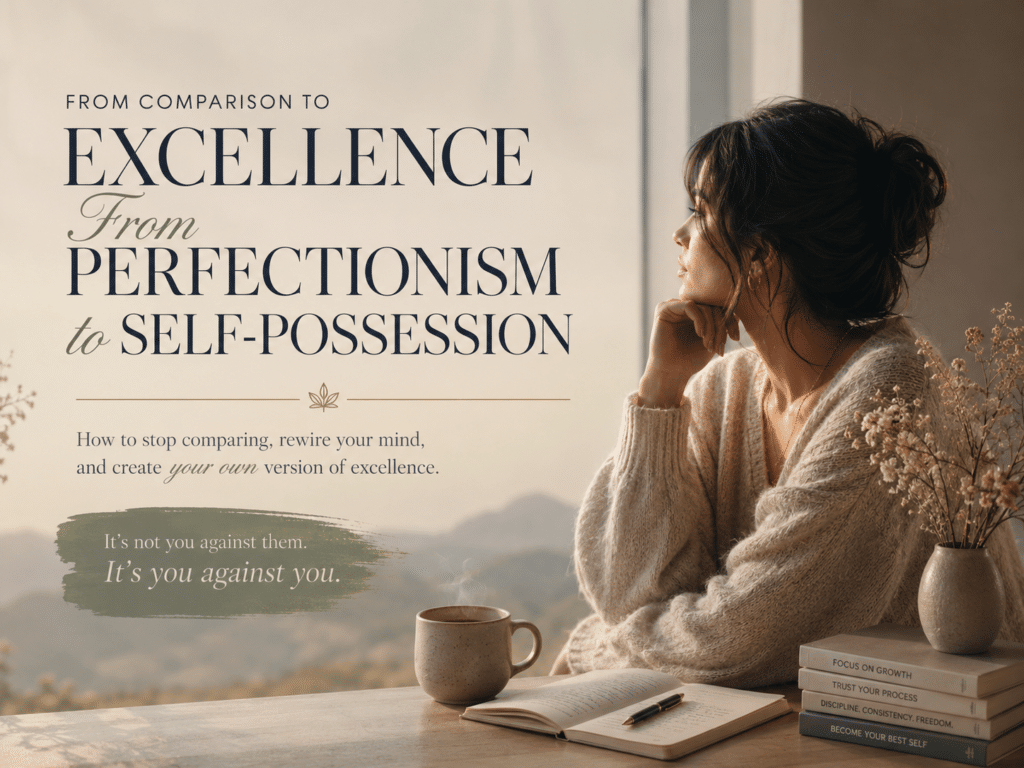
Recently, I was watching a powerful conversation between Mel Robbins and Emma Grede, and something they said stopped me in my tracks. It explained, so clearly, the difference between pursuing excellence and getting trapped in perfectionism.
For many of us — especially those raised in environments where comparison was normal — this distinction can be life-changing.
The Conversation
Mel asked Emma:
“How do you pursue excellence versus the trap of being perfect? What’s the difference between excellence and that perfectionism trap that women get stuck in?”
Emma replied with something deeply insightful:
“We all have a different measuring stick. What is perfect to you is not perfect to me. We have to be realistic with ourselves. I’m not looking in the media, on social media, or in magazines trying to live up to that version. I’m asking: What is my version of excellence based on where I come from and who I am? What is good enough for me? Because I’m not comparing myself to anyone else. It’s you against you.”
Then Mel beautifully summarized it:
“Perfectionism is when you are focused on the outside. Perfectionism is when you are measuring what other people are going to think about what you just did.
Excellence is on the inside. Excellence is about the effort you put in and whether or not that effort is good enough for you.”
That is profound.
Because many of us have misunderstood perfectionism as something internal. But often, it is actually external pressure internalized.

Why This Hit Me So Deeply
When I heard this, I realized something important:
I was not raised in an environment where life was measured internally. I was raised in an environment where everything started and ended with comparison.
- Compared to neighbors
- Compared to cousins
- Compared to relatives
- Compared to classmates
- Compared to “who is doing better”
From childhood, the nervous system learned:
- Look outside for worth
- Measure yourself constantly
- Feel behind
- Chase approval
- Compete for value
So now, as an adult, when I look at other artists online, I compare myself automatically. And that comparison can feel so natural that it seems like who I am.
But it is not who I am. It is conditioning.
This Is Not a Personality Flaw — It Is Nervous System Training
When a child grows up in an environment where love, approval, praise, safety, or worth are linked to how they rank compared to others, the brain learns:
- Scan constantly: “Who is ahead of me?”
- Measure self through external standards
- Anticipate judgment
- Feel unsafe when someone else succeeds
- Feel temporarily okay only when outperforming someone
That pattern can continue into adulthood, even when you intellectually know it’s unhealthy.
So if comparison feels automatic, it does not mean you are broken. It means you were trained. And what was trained can be retrained.
What Emma Is Really Describing: Re-parenting the Mind
Emma’s mindset is not accidental. She is describing an inner world where the measuring stick became internal rather than external.
The shift looks like this:
Old Programming:
How am I doing compared to them?
New Programming:
How am I doing compared to who I was yesterday?
That is the real move from perfectionism to excellence.
Why Social Media Feels So Triggering
Social media is built to amplify comparison. It’s basically a comparison machine.
For someone raised in comparison culture, it activates old pathways instantly:
- She is better than me
- They are ahead
- I started too late
- I am behind
- I should be further along
So what looks like “social media insecurity” is often childhood comparison conditioning getting reactivated.
That insight alone can create compassion.
The Goal Is Not to Never Compare
You are human. Comparison may still happen.
The real goal is: Comparison no longer controls your identity.
That is freedom.
How to Shift from External Comparison to Inner Excellence

1. Catch the Inherited Voice
When comparison starts, pause and ask: Whose voice is this? Is it truly yours? Or is it:
- parents
- relatives
- school systems
- cultural pressure
- scarcity thinking
Often it’s old voices living rent-free in the mind. When you name it, you weaken it.
Say: “This is inherited programming, not my truth.”
2. Build a Personal Scoreboard
Stop measuring by public metrics. Instead, create your own metrics that have nothing to do with others.
- Did I create today?
- Did I show courage?
- Did I improve one skill?
- Did I stay consistent?
- Did I finish something?
- Did I express something honest?
That is excellence.
Not followers.
Not likes.
Not someone else’s timeline.

3. Turn Envy into Evidence
When another artist triggers insecurity, shift from:
She is ahead, I am behind.
To:
She is evidence of what is possible.
This changes the nervous system from threat to expansion.
4. Practice “Me vs Me” Every Evening
Every evening ask:
- Where was I stronger than old me?
- Where did I act with more courage?
- Where did I improve?
- What did I learn?
- What can tomorrow’s version do better?
Now growth becomes personal. Now the brain starts searching for self-growth instead of competitors.
5. Protect Your Healing
If certain accounts make you spiral, mute them.
That is not weakness. That is wisdom. That is protecting your nervous system while healing.
You do not ask an injured leg to run a marathon.
6. Replace Performance Identity with Process Identity
Old Identity:
I matter when I am better than others.
New Identity:
I am worthy because I create, grow, learn, and show up.
This is powerful healing.
7. Speak to Yourself the Way You Needed
Many people from comparison-based homes never heard unconditional emotional support. So now you must give it to yourself:
- I am allowed to grow at my pace.
- My pace is valid.
- Someone else shining does not dim me.
- I do not need to win to matter.
- I can be excellent without being first.
- My journey counts.
At first, this may feel unnatural. That only means the old voice had more practice. Keep going.

A Truth About Competitive Upbringings
Many people raised in highly comparison-driven cultures become successful externally but exhausted internally.
They learn how to compete. They do not know how to belong to themselves.
Your next level is not more competition. It is self-possession.
Why Comparison Is Dangerous (For Artists)
Comparison kills art, because art needs:
- play
- experimentation
- mistakes
- slow growth
- weirdness
- honesty
- authenticity
Comparison says: Be impressive immediately.
Art says: Be real first.
Choose art.
A 30-Second Reset When Triggered
When you see another artist and feel small:
- Put a hand on your heart
- Take one slow breath
- Say: “I bless their path. I return to mine.”
Then ask: What do I need to create today?
That is power.
Your New Definition of Excellence
Excellence may no longer mean outperforming others.
It may mean:
- Showing up despite old conditioning
- Creating despite fear
- Growing at your own pace
- Building a career despite late starts
- Choosing self-worth over comparison
- Becoming emotionally free while thriving
That is a deeper excellence.
Final Truth
You do not need to become Emma. You do not need to become anyone else.
You need to become you without inherited comparison.
That version of you is likely peaceful, powerful, creative, and already waiting underneath decades of conditioning.



Debasree I just discovered you today! I needed this post and I needed to see you creating with freedom. I was having an intensely discouraging day. Trying to figure out who I am, what my art is and where my art belongs. Feeling disappointed by late starts and success that is slow to come. This was the reset I needed. I’m so excited to try your methods of play. Thank you so much <3.